
Carl XVI Gustaf
Longest-reigning Swedish monarch; reign defined by ceremonial role.

Lennart Bergqvist · CC BY 4.0
Carl XVI Gustaf (Carl Gustaf Folke Hubertus) has been Sweden’s king since 15 September 1973. With a reign of 52 years, he holds the record as the longest-serving monarch in Swedish history and is the second longest-serving current head of state anywhere. Born on 30 April 1946 at Haga Palace in Solna, he was the youngest of five children and the only son of Prince Gustaf Adolf, Duke of Västerbotten, and Princess Sibylla of Saxe-Coburg and Gotha. His father died in a plane crash in Denmark in January 1947, when Carl Gustaf was nine months old. At age four, after his great-grandfather King Gustaf V died in 1950, he became crown prince and heir apparent when his grandfather ascended the throne as Gustaf VI Adolf.
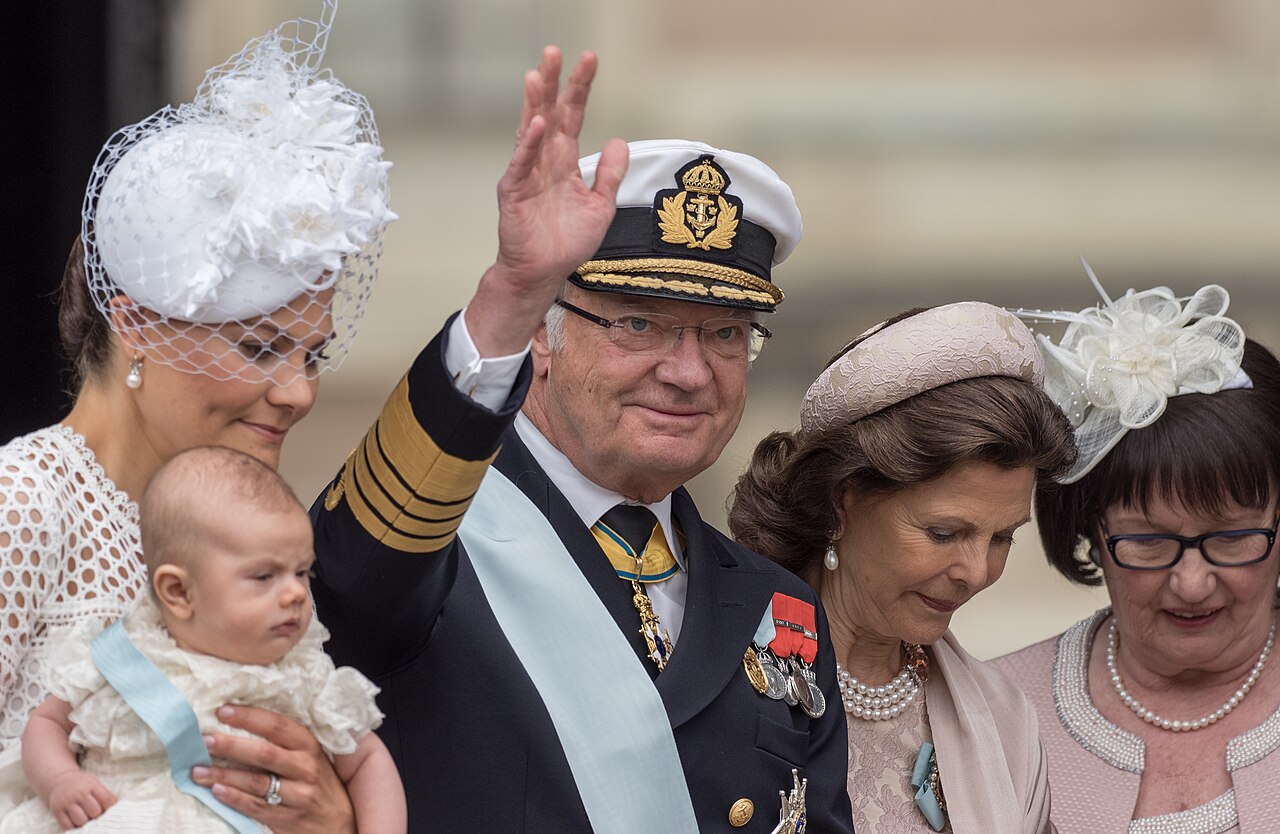
He was christened on 7 June 1946 in the Royal Chapel by Archbishop Erling Eidem. The ceremony used Charles XI’s baptismal font placed on Gustav III’s carpet, with the infant lying in Charles XI’s cradle beside Oscar II’s crown. The white linen batiste gown he wore had previously been worn by his father in 1906 and would later be used by each of his three children. His godparents included the Crown Prince and Crown Princess of Denmark, the Crown Prince of Norway, Princess Juliana of the Netherlands, King Gustaf V, the Hereditary Prince of Saxe-Coburg and Gotha, the Crown Prince and Crown Princess of Sweden, and Count Folke and Countess Maria Bernadotte of Wisborg. He was also given the title Duke of Jämtland. Carl Gustaf was seven before he learned of his father’s death; he later spoke about growing up without him in a 2005 speech.
His early education came privately at the Royal Palace, followed by Broms school and then Sigtuna boarding school. After graduating high school in 1966, he spent two and a half years training with the Swedish Army, Navy, and Air Force. During the winter of 1966–67, he sailed around the world on the mine-laying vessel Älvsnabben. He received officer commissions in all three services in 1968, eventually reaching captain in the army and air force and lieutenant in the navy before becoming king. He studied history, sociology, political science, tax law, and economics at Uppsala University, and later economics at Stockholm University. To prepare for his role, he examined the court system, social organisations, trade unions, employers’ associations, and the workings of the Riksdag, Government, and Ministry for Foreign Affairs. He
- born
- 30 April 1946
- field
- Monarchy
- nationality
- Swedish
- known_for
- Longest-reigning Swedish monarch; reign saw Sweden join NATO in 2024
Lore & Background
Carl Gustaf was born at Haga Palace in Solna, Stockholm County, the youngest child and only son of Prince Gustaf Adolf and Princess Sibylla. His father died in an airplane crash in Denmark in January 1947, when Carl Gustaf was nine months old. He became crown prince at age four when his grandfather Gustaf VI Adolf acceded to the throne in 1950. He acceded to the throne upon his grandfather's death on 15 September 1973. Shortly after, the 1974 Instrument of Government took effect, stripping the monarchy of executive powers, including formal appointment of the prime minister, signing legislation, and being commander-in-chief. The king retained ceremonial functions and the right to be informed of state affairs.
Carl Gustaf married Silvia Sommerlath in June 1976; they have three children: Victoria, Carl Philip, and Madeleine. After a 1980 law establishing absolute primogeniture, his heir became Crown Princess Victoria. He has dyslexia, as do two of his children. He holds honorary doctoral degrees from several Swedish and Finnish universities. In 2018, he became the longest-reigning Swedish monarch, surpassing Magnus Eriksson. His Golden Jubilee was celebrated in 2023. Following the abdication of his cousin Margrethe II of Denmark, he became the longest-serving incumbent head of state in Europe. His reign saw Sweden end over 200 years of neutrality by joining NATO on 18 March 2024.
Reader's Guide
Carl XVI Gustaf's significance lies in his role as a constitutional monarch whose reign witnessed the formal removal of royal executive powers, transforming the Swedish monarchy into a purely ceremonial institution. He became the longest-reigning Swedish monarch in 2018, a testament to his longevity on the throne. His reign also saw Sweden join NATO in 2024, ending a long-standing policy of neutrality. Despite controversies over political statements, public support for the monarchy remained strong, largely due to the popularity of Crown Princess Victoria. His legacy is that of a modern, figurehead monarch who adapted to a diminished constitutional role while maintaining the monarchy's symbolic importance in Swedish society.
Did You Know?
- Carl Gustaf became crown prince at age four when his grandfather acceded to the throne in 1950.
- He has dyslexia, as do his daughter Crown Princess Victoria and his son Prince Carl Philip.
- He became the longest-reigning Swedish monarch on 26 April 2018, surpassing Magnus Eriksson.
- His reign saw Sweden join NATO on 18 March 2024, ending over 200 years of neutrality.
A Childhood Defined by Sudden Loss
Carl Gustaf entered the world on 30 April 1946 at Haga Palace in Solna, the youngest of five siblings and the sole son of Prince Gustaf Adolf and Princess Sibylla. His christening, held on 7 June at the Royal Chapel, was steeped in dynastic ritual: he lay in the cradle of Charles XI, was baptized in that monarch's font, and wore a white linen batiste gown his father had worn in 1906. Yet the fragility of royal life struck almost immediately. On 26 January 1947, his father perished in an airplane crash at Copenhagen Airport, leaving the infant prince with no memory of the man who would have been his king. The boy was not told of his father's death until he was seven years old. When his great-grandfather Gustaf V passed in 1950, the four-year-old Carl Gustaf became heir apparent to the Swedish throne, a responsibility that would define his entire life. In a 2005 speech, he reflected openly on the emotional weight of growing up without ever knowing his father.
Forging a Monarch Through Study and Service
Before ever sitting on the Silver Throne, Carl Gustaf undertook an unusually wide-ranging education. After private tutoring at the Royal Palace, he attended Broms school and Sigtuna boarding school, graduating from high school in 1966. He then spent two and a half years in the Swedish Army, Navy, and Air Force, including a round-the-world voyage aboard the mine-laying vessel Älvsnabben during the winter of 1966–67. He earned his officer's commission in all three services by 1968, rising to captain in the army and air force and lieutenant in the navy. Academically, he studied history, sociology, political science, tax law, and economics at Uppsala University, followed by further economics at Stockholm University. To prepare for head-of-state duties, he immersed himself in the workings of the Riksdag, the Government, and the Ministry for Foreign Affairs. He also worked at a bank, the Swedish embassy in London, the Swedish Chamber of Commerce, the Alfa Laval factory in France, and spent time at Sweden's UN mission and at SIDA. Despite a lifelong dyslexia shared with two of his children, he has collected honorary doctorates from four institutions across Sweden and Finland.
A Throne Transformed by Constitution
Carl Gustaf's accession on 15 September 1973, following the death of his grandfather Gustaf VI Adolf, was immediately followed by a constitutional revolution that redefined the Swedish monarchy. Four days later he delivered his regal assurance before the cabinet, then appeared in the Hall of State to be enthroned on the Silver Throne before parliament, the diplomatic corps, and the court—a ceremony broadcast live on television. But the most consequential change came with the new 1974 Instrument of Government, which formally stripped the crown of its remaining executive authority. The king could no longer appoint the prime minister, sign legislation into law, or serve as commander-in-chief. His role was explicitly confined to ceremonial and representative functions, though he retained the right to be regularly informed of state affairs. As head of the House of Bernadotte, he nonetheless preserved the ability to make decisions regarding the titles and positions of family members. His first state visit as king, in October 1974, took him to Norway to meet his godfather, King Olav V.
Building a Royal Family and a New Order of Succession
In June 1976, Carl Gustaf married Silvia Sommerlath, and the couple went on to have three children: Victoria, Carl Philip, and Madeleine. The question of succession took on new significance when, on 1 January 1980, Sweden passed a law establishing absolute primogeniture, meaning the eldest child regardless of sex would inherit the throne. This made Crown Princess Victoria the heir apparent. Her younger brother Carl Philip, born in May 1979, had briefly held the position of heir apparent from his birth until the new law took effect. The christening gown Carl Gustaf had worn as an infant in 1946—the same white linen batiste garment his father had worn in 1906—would later be passed to his three children, creating a tangible thread connecting three generations of the Bernadotte line. The king's family thus became the living embodiment of a monarchy that, while stripped of executive power, continued to anchor Sweden's national identity through continuity, representation, and the quiet persistence of tradition.
Gallery
More in Royalty And Heads Of State 1-24
Elsewhere in the Royalty And Heads Of State universe
Spotted an error? Know more?
This is a living reference — every entry is fact-audited, and reader corrections feed straight into our audit queue. Suggest an edit · See this site's audit record